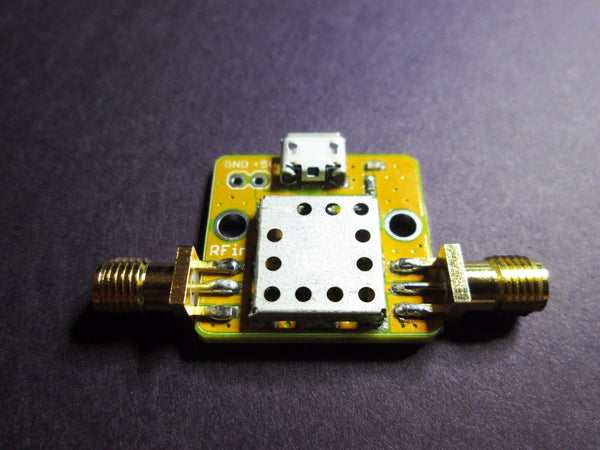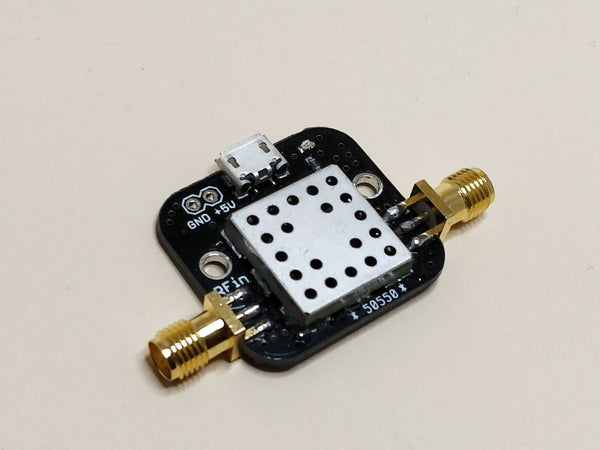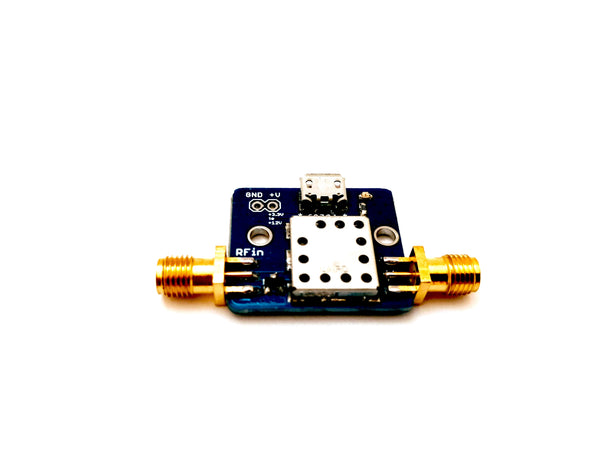


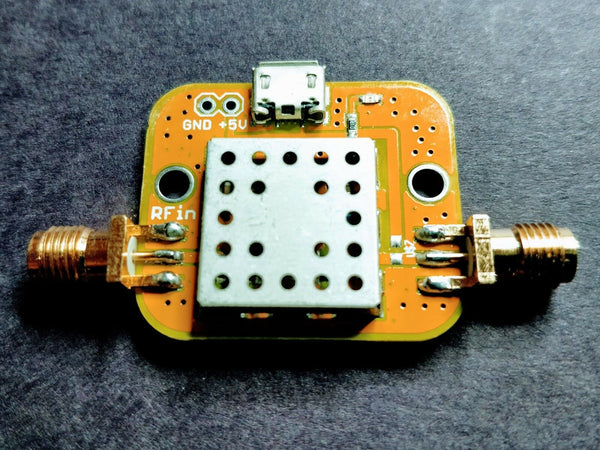


PRODUCT OVERVIEW
GNSS signals arrive at the antenna extremely weak, and a long cable run between an outdoor antenna and an indoor receiver costs you signal before it ever reaches your equipment. This amplifier solves both problems in one part: it boosts the GNSS signal with 25 dB of gain and a 1 dB noise figure, and its integrated bias tee sends DC power down the same coax, so you don't need a separate power cable running to your antenna.
It covers GPS L1 through L5, BeiDou, GLONASS, and NAVIC, with filtering built into the amplifier itself for excellent rejection of nearby cellular, LTE, and ISM band interference. Operating range is -40°C to +85°C, suitable for outdoor, antenna-mounted installation.
Power it one of three ways: a Micro-USB cable, +5VDC to +12VDC on the DC header, or the integrated bias tee itself (+5VDC to +12VDC). If your setup already runs power to the antenna over the same coax, the bias tee is almost always the simplest choice, since it eliminates the separate power cable entirely. Use the DC header or Micro-USB instead if you're powering this unit in isolation, on a bench, or somewhere a coax-based power path doesn't fit your setup.
This LNA draws 100 mA at 3.3V or higher, more than most GNSS receivers can supply through their own antenna bias pin, which typically provides only 5 to 20 mA. An underpowered LNA won't fail outright, it will current-limit quietly and never reach its rated gain or noise figure. GPIO Labs' GNSS Filtered Bias Tee solves this by injecting power independently of your receiver while filtering nearby interference on the same line.
⚠️ Important: Because the bias tee is installed, powering this unit via the DC header or USB connector will put +5VDC on the RF output. If your receiver doesn't have a DC blocking capacitor or other voltage protection on its input, this will damage your receiver. Confirm your receiver's input protection before connecting power.
Need the same amplifier without integrated power injection? See the standard GNSS LNA.
APPLICATIONS
- GNSS reception in weak-signal environments where cable loss between antenna and receiver is a concern
- Rooftop, mast, or vehicle-mounted antenna installs where running a separate power cable alongside the coax isn't practical
- Rejecting strong nearby cellular, LTE, UHF, 915 MHz, and 2.4 GHz ISM interference before it reaches your receiver
- Multi-constellation GNSS receivers needing simultaneous GPS, GLONASS, BeiDou, and NAVIC coverage from a single front end
SPECIFICATIONS
Passband
1100 MHz - 1700 MHz
Frequency ........... Gain
100 MHz ......... -2 dB
200 MHz ......... 3 dB
500 MHz ......... 10 dB
900 MHz ......... -2 dB
1000 MHz ......... -2 dB
1100 MHz ......... 30 dB
1200 MHz ......... 28 dB
1300 MHz ......... 26 dB
1400 MHz ......... 25 dB
1500 MHz ......... 25 dB
1600 MHz ......... 24 dB
1700 MHz ......... 24 dB
1800 MHz ......... 18 dB
1900 MHz ......... 6 dB
2000 MHz ......... -10 dB
2400 MHz ......... -5 dB
3000 MHz ......... -10 dB
NOTES
The filter uses SMA-F connectors.
This item can be powered using DC on the RF cable.
Max RF Input = -15 dBm
RELATED PRODUCTS
BANDS COVERED
GPS (USA)
| Frequency | Name | Use |
|---|---|---|
| 1575.42 MHz | L1 | Civil (C/A code), military (P(Y) code) |
| 1227.60 MHz | L2 | Military P(Y), civilian L2C |
| 1381.05 MHz | L3 | Nuclear detonation detection |
| 1379.91 MHz | L4 | Experimental ionospheric research |
| 1176.45 MHz | L5 | Safety-of-life, high accuracy civil |
GLONASS (Russia)
| Band | Frequency Range | Use |
|---|---|---|
| 1598.0625–1605.375 MHz | L1 (G1) | Civil standard |
| 1242.9375–1248.625 MHz | L2 (G2) | Civil/military |
| 1202.025 MHz | L3 (G3) | CDMA, interoperability with GPS L5 |
Galileo (EU)
| Frequency | Name | Use |
|---|---|---|
| 1575.42 MHz | E1 | Open service, shared with GPS L1 |
| 1191.795 MHz | E5 | Broadband, highest accuracy civil signal |
| 1176.45 MHz | E5a | Open service, interoperable with GPS L5 |
| 1207.14 MHz | E5b | Open service, high integrity |
| 1278.75 MHz | E6 | Commercial/authenticated service (HAS) |
BeiDou (China)
| Frequency | Name | Use |
|---|---|---|
| 1561.098 MHz | B1I | Legacy open service (BDS-2) |
| 1575.42 MHz | B1C | Modern open service (BDS-3), interop with GPS L1/Galileo E1 |
| 1176.45 MHz | B2a | Open service (BDS-3), interop with GPS L5/Galileo E5a |
| 1207.14 MHz | B2b | Open service (BDS-3), PPP service |
| 1191.795 MHz | B2 (B2a+B2b) | Wideband, same center as Galileo E5 |
| 1268.52 MHz | B3I | Authorized service |
NavIC (India)
| Frequency | Name | Use |
|---|---|---|
| 1176.45 MHz | L5 | Standard positioning service |
QZSS (Japan)
| Frequency | Name | Use |
|---|---|---|
| 1575.42 MHz | L1 | Interoperable with GPS L1 |
| 1227.60 MHz | L2 | Interoperable with GPS L2 |
| 1176.45 MHz | L5 | Interoperable with GPS L5 |
| 1278.75 MHz | L6 (LEX) | Centimeter-level augmentation (CLAS service) |
You might also like