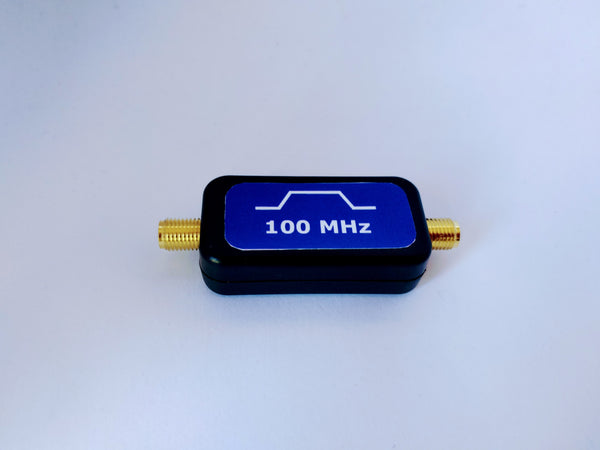
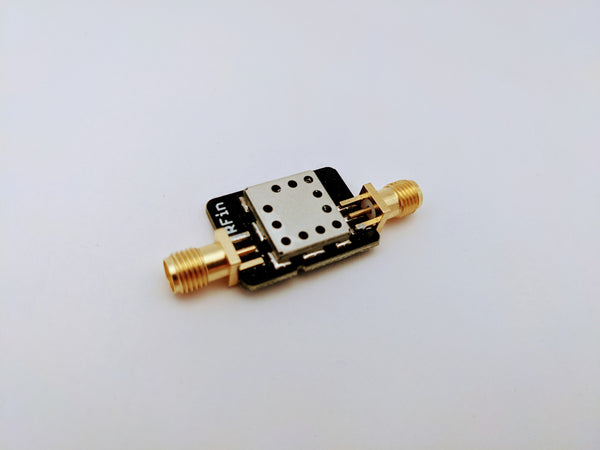
This 426 MHz bandpass filter is designed for receive applications across approximately 416 to 436 MHz, making it particularly well suited for 70 cm Amateur Television (ATV), SDR receivers, spectrum monitoring systems, and other UHF receiver applications.
With a center frequency of 426 MHz and a bandwidth of approximately 20 MHz, the filter comfortably covers the 420–432 MHz ATV spectrum used in the United States while also extending into the important 432 MHz weak-signal and EME region.
The filter provides approximately 2.5 dB insertion loss at the center of the passband and strong rejection of signals outside the desired frequency range. This helps reduce receiver overload, desensitization, and interference from strong out-of-band signals.
Designed for 70 cm Amateur Television
One of the primary applications for this filter is ATV reception in the 70 cm amateur band.
The 420–432 MHz ATV spectrum falls almost entirely at the center of the filter's usable passband, making the filter suitable for:
- ATV receiver front ends
- ATV repeaters and monitoring receivers
- SDR-based ATV reception
- Amateur television experimentation
- Wideband 70 cm signal monitoring
Because the filter is centered at 426 MHz, it provides useful coverage on both sides of the center frequency for wideband ATV signals.
SDR Receiver Preselection
Wideband SDR receivers can easily become overloaded by strong signals outside the frequency range of interest.
Placed ahead of an SDR or receiver, this filter acts as a 420 MHz / 430 MHz preselector, allowing signals in the 416–436 MHz region to pass while attenuating unwanted signals farther outside the band.
Typical applications include:
- RTL-SDR receivers
- Airspy receivers
- HackRF
- USRP platforms
- Spectrum monitoring systems
- RF test equipment
- Custom receiver designs
A typical receiver configuration is:
Antenna → 426 MHz Bandpass Filter → LNA → SDR / Receiver
In environments with particularly strong interference, placing the filter before the LNA can also help prevent LNA compression or intermodulation.
432 MHz Weak-Signal and EME Reception
The filter passband includes 432 MHz, an important frequency region for weak-signal amateur radio operation.
It can therefore be used in receiver chains for:
- 432 MHz weak-signal reception
- Earth-Moon-Earth (EME) monitoring
- Propagation experiments
- Beacon monitoring
- 70 cm amateur radio experimentation
The relatively wide passband makes the filter useful where a broader section of the 70 cm spectrum needs to be monitored rather than a single narrow channel.
Spectrum Monitoring and RF Research
The 416–436 MHz passband also makes this filter useful for general UHF spectrum analysis and receiver development.
Applications include:
- Spectrum surveys
- Interference hunting
- Signal identification
- Telemetry monitoring
- RF research
- Receiver prototyping
- Laboratory test systems
The filter can be used anywhere a receiver needs improved rejection of signals outside approximately 416–436 MHz.
Receiver Protection from Out-of-Band Signals
Strong nearby transmitters can reduce the performance of sensitive SDRs, LNAs, and receiver front ends even when those transmitters operate outside the frequency being monitored.
This filter helps isolate the desired portion of the UHF spectrum and can improve receiver performance by reducing:
- Receiver overload
- ADC clipping in SDRs
- LNA compression
- Intermodulation products
- Out-of-band interference
This is particularly useful when using broadband antennas that receive signals across a much wider frequency range than the receiver actually needs.
Specifications
Center Frequency: 426 MHz
Passband: Approximately 416–436 MHz
Bandwidth: Approximately 20 MHz
Typical Insertion Loss: Approximately 2.5 dB at center frequency
Out-of-Band Rejection: Approximately 30 dB or greater at 400 MHz and 500 MHz
Maximum RF Input Power: +15 dBm
Operating Temperature: -40°C to +85°C
RF Connectors: SMA Female
Typical Applications
- 70 cm Amateur Television (ATV) reception
- 420–432 MHz ATV receiver preselection
- 426 MHz SDR filtering
- 432 MHz weak-signal reception
- EME receiver systems
- Spectrum monitoring
- RF interference hunting
- Telemetry reception
- UHF receiver development
- Laboratory and research systems
Important Note
This filter has a maximum RF input power of +15 dBm and is intended primarily for receive-side filtering and low-power RF signal conditioning.
It should not be connected directly to the output of a typical amateur radio or ATV transmitter.