PRODUCT OVERVIEW
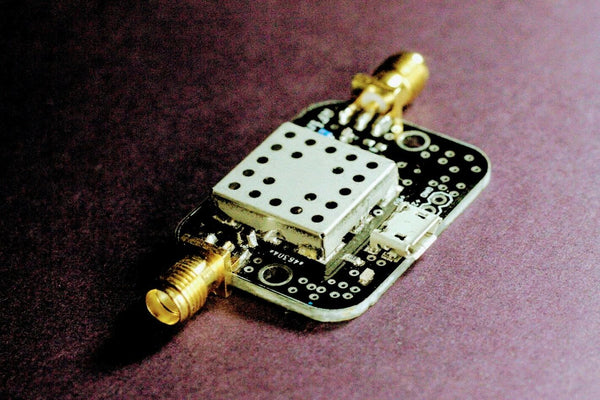
GPS L1 signals arrive at the antenna extremely weak, and any nearby cellular, LTE, or ISM-band interference can swamp a receiver before it ever gets a clean look at the satellite signal. This LNA solves both problems in one part: a 23 dB gain stage with sub-1 dB noise figure, paired with filtering built directly into the amplifier itself rather than added as a separate inline part, centered tightly on 1575.42 MHz. A +29 dBm OIP3 rating sets it apart from most competing GPS LNAs, keeping it linear even when strong out-of-band signals are present nearby, not just in a quiet lab environment.
Operating range is -40°C to +85°C, suitable for outdoor, antenna-mounted installation. Maximum RF input is -5 dBm, do not exceed this level at the input, since doing so can compress or permanently damage the amplifier.
Three ways to handle power in this product family:
- This LNA (no DC pass-through): the simplest option if you're using a passive antenna, or if your antenna is already powered some other way. DC is fully blocked in both directions.
- Output bias tee version: adds a bias tee on the output side, letting you power the LNA itself through that connection, but still does not pass DC through to an antenna on the input side. Good if you need a flexible power option for the amplifier without powering anything upstream of it.
- Input and output bias tee version, DC pass-through: passes DC all the way through, so an active antenna connected ahead of this LNA receives power from your receiver as normal. Choose this version if your antenna needs power and you want that power delivered through the existing signal chain.
Need to power an active antenna independently instead? Our GPS Filtered Bias Tee (+3.3V) injects power onto the same coax carrying your RF signal, with GNSS-band filtering built in, so you can pair it with this no-pass-through LNA and still power your antenna without needing the DC pass-through variant at all.
APPLICATIONS
- GPS L1 signal reception in a weak signal environment
- Rejection of strong signals in Cellular, LTE, UHF and 915 MHz, 2.4 GHz ISM bands
- GPS L1 signal processing
KEY SPECIFICATIONS OVERVIEW
- Gain of 23 dB is in the sweet spot for GPS systems - used to boost extremely weak satellite signals before they are degraded by cable loss, filters, and receiver electronics
- Noise figure of less than 1 dB (typically 0.8 dB). This improves GPS sensitivity, increases carrier-to-noise ratio, and allows the receiver to detect satellites faster and in weaker signal conditions.
- The IP3 specification (+29 dBm) differentiates this LNA from others on the market. High IP3 amplifiers handle strong nearby signals without generating distortion.
SPECIFICATIONS
PASSBAND 1575 + 7.5 MHz
Frequency Gain
850 MHz -13 dB
1500 MHz -9 dB
1535 MHz -5 dB
1575 MHz +23 dB
1615 MHz -16 dB
1640 MHz -18 dB
1700 MHz -20 dB
Current Consumption at +3.3V = 75 mA
Operating Temperature Range = -40C to +85C
Noise Figure < 1 dB
Max RF Input = -5 dBm
Output IP3 = +29 dBm
Output P1dB = +18 dBm
Note: The filter uses SMA-F connectors.
RELATED PRODUCTS
You might also like