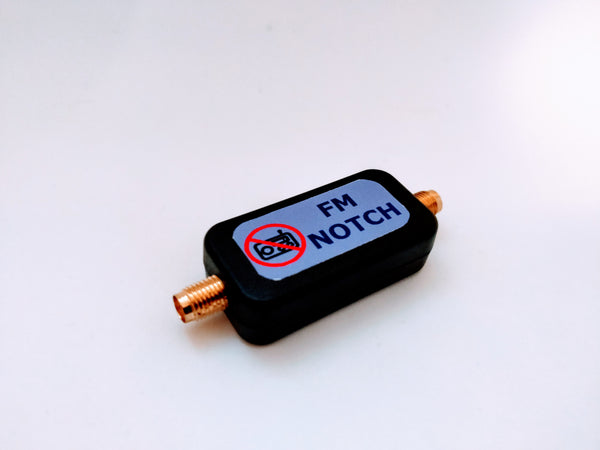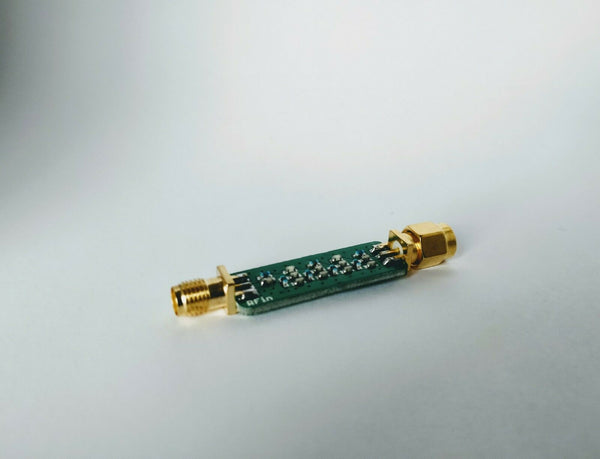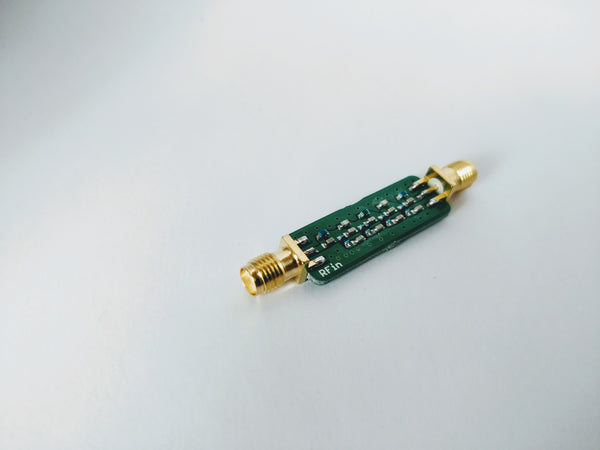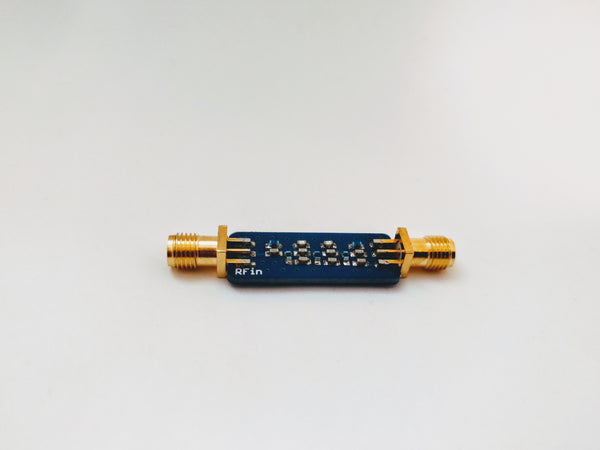


PRODUCT OVERVIEW
If your SDR, airband receiver, or handheld radio is picking up noise, distortion, or garbled signals across frequencies that have nothing to do with FM radio, strong nearby FM transmitters are almost certainly the cause. FM broadcast stations operate at some of the highest power levels of any terrestrial transmitter, and wideband receivers have essentially no built-in protection against them.
This filter solves that problem by blocking the entire 88 to 108 MHz FM broadcast band before it ever reaches your receiver's front end.
This is a 7th-order notch filter, rejecting FM energy by up to 72 dB at 100 MHz while passing signals above 118 MHz with less than 0.5 dB of insertion loss. That asymmetric response is deliberate: it has been optimized specifically for airband reception in the 118–136 MHz range, where FM overload is the single most common cause of degraded performance.
It also works seamlessly for SDR setups, RTL-SDR dongles, ADS-B receivers, VHF monitoring, and any application where strong FM broadcast energy needs to be removed from the signal chain.
The filter passes signals from 50 MHz to 80 MHz and from 110 MHz to 3 GHz with minimal loss, making it effective across a very wide range of use cases beyond airband alone.
ATTENUATION TABLE
| Frequency | Typical Attenuation |
|---|---|
| 50–80 MHz | < 0.5 dB |
| 90 MHz | 52 dB |
| 100 MHz (FM band centre) | 72 dB |
| 110 MHz | 6 dB |
| 120 MHz | 1 dB |
| 130–200 MHz | < 0.5 dB |
| 200–2700 MHz | < 1.5 dB |
| 2700–3000 MHz | < 4.0 dB |
72 dB of rejection at the FM band centre means a 100 MHz FM transmitter arrives at your receiver more than 15 million times weaker than it would without this filter. At 120 MHz (the lower edge of the airband) only 1 dB of signal is lost.
APPLICATIONS
- Airband reception (118–136 MHz) near strong FM transmitters
- RTL-SDR and wideband SDR setups experiencing FM overload or spurious signals
- ADS-B receivers at 1090 MHz where FM energy is degrading sensitivity
- VHF spectrum monitoring in urban environments
- Handheld radios with poor front-end selectivity used near high-power FM sites
- Any receive chain where FM broadcast energy is consuming dynamic range intended for other signals
NOTES
- SMA-F connectors
- Maximum RF input: +30 dBm (1 Watt) — suitable for transmit-path use as well as receive-only applications
- Works with both North American FM (88–108 MHz) and Japanese FM (76–95 MHz) broadcasting, providing meaningful rejection across the full Japanese band as well as the North American allocation
- For permanent outdoor or weatherproof installation, see the enclosed version
CASE STUDY
Ethan lives a few kilometres from Auckland's Sky Tower, home to the world's largest FM antenna combiner: 23 FM stations broadcasting simultaneously from a single 328-metre structure. His solution was a GPIO Labs FM Notch Filter on every SDR he owns. Read the full story:
→ Surviving the World's Busiest FM Antenna Site with a GPIO Labs FM Notch Filter