PRODUCT OVERVIEW
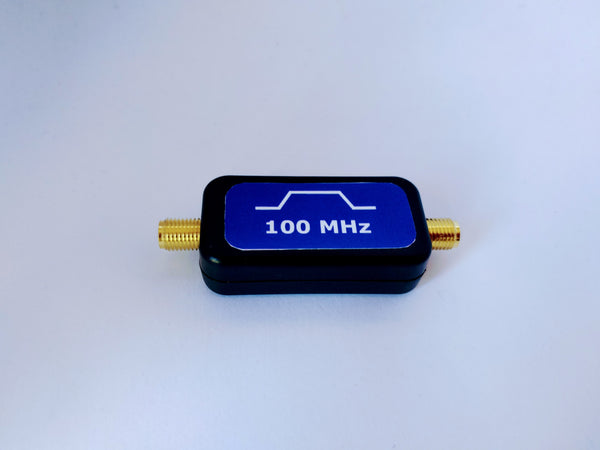
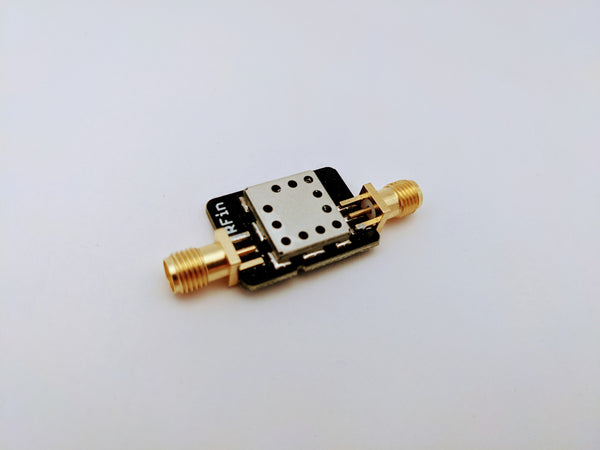
This is a 3rd order wideband AIS bandpass filter with excellent rejection of the FM broadcast band. In the absence of a bandpass filter, strong signals in adjacent bands such as FM can saturate the receiver.
The AIS or Automatic Identification System operates at 161.975 MHz & 162.025 MHz (Channels 87B/88B) for standard vessel-to-vessel and shore-station reception. This filter also passes 156.775 MHz & 156.825 MHz (Channels 75/76) — the frequencies used for AIS Message 27, the long-range broadcast format defined in ITU-R M.1371-5 and designed for satellite (S-AIS) detection of vessels far beyond standard VHF range. The filter also extends to cover DSC Channel 70 (156.525 MHz), which AIS transponders monitor for digital selective calling management messages.
The passband also covers all seven weather radio frequencies used in the United States (NOAA NWR) and Canada (Weatheradio Canada).
Why a Wideband AIS Filter?
Many AIS filter and LNA modules use a SAW filter centered on 162 MHz. SAW filters are narrow and typically pass only a segment of the band around Channels 87B/88B, attenuating the long-range AIS and DSC channels. This filter covers the full range from 156.525 MHz to 162.550 MHz, so a single receive chain can capture standard AIS, long-range AIS Message 27, DSC Channel 70, and weather radio.
For weak-signal reception, see our AIS Filtered Low Noise Amplifier.
FREQUENCIES COVERED
|
Channel |
Frequency (MHz) |
Use |
|
70 |
156.525 |
DSC (digital selective calling) |
|
75 |
156.775 |
AIS Message 27 long-range broadcast (S-AIS) |
|
76 |
156.825 |
AIS Message 27 long-range broadcast (S-AIS) |
|
87B |
161.975 |
AIS Channel A |
|
88B |
162.025 |
AIS Channel B |
|
WX1 - WX7 |
162.400 - 162.550 |
NOAA Weather Radio / Weatheradio Canada |
APPLICATIONS
- AIS receivers and SDR-based ship tracking
- Long-range and satellite AIS (Message 27) reception
- Marine monitoring, coastal stations, and DSC reception
- NOAA Weather Radio and Weatheradio Canada reception
- Rejecting FM broadcast (88 - 108 MHz) interference ahead of SDRs, embedded telemetry, and RF front-ends
SPECIFICATIONS
Passband: 156.5 - 162.6 MHz (all channels listed above)
Insertion loss: 2.8 dB typical at 160 - 162 MHz
|
Frequency (MHz) |
Typical Attenuation (dB) |
|
88 |
68 |
|
98 |
60 |
|
108 |
50 |
|
130 |
23 |
|
140 |
7 |
|
150 |
4 |
|
156 |
3 |
|
160 |
2.8 |
|
162 |
2.8 |
|
165 |
4 |
|
180 |
9 |
|
250 |
30 |
|
500 |
42 |
NOTES
- The filter uses SMA-F connectors.
- The maximum RF input power for this filter is +30 dBm (1 Watt).

Image from hackerfantastic