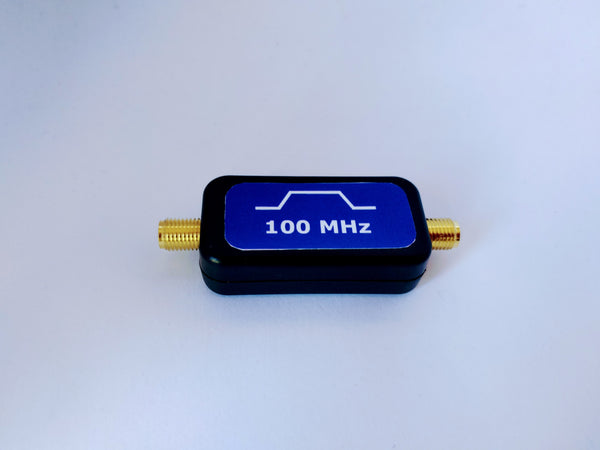
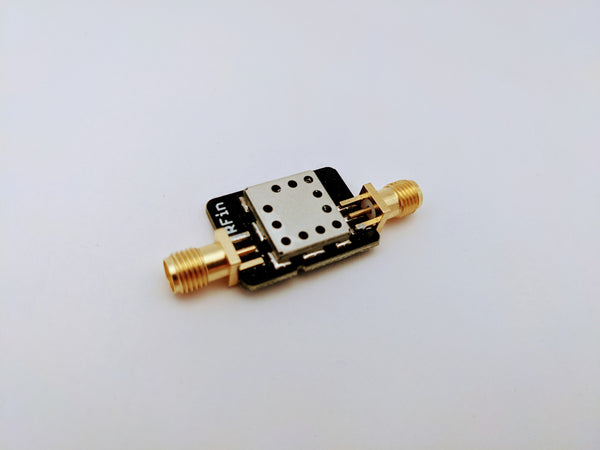
PRODUCT DESCRIPTION
This is a small, cost-effective bandpass filter covering 118–138 MHz. The FM broadcast band sits immediately below it at 88–108 MHz, and strong local FM stations are a common source of interference for airband listening.
This filter provides over 25 dB of attenuation by 98 MHz and over 40 dB by 78 MHz, rejecting that nearby broadcast energy before it reaches your receiver.
Also available in
or with SMA-M and SMA-F connectors
BACKGROUND
The Airband, or aircraft band, is the VHF frequency range used for civil aviation radio communication worldwide — air traffic control, pilot communications, and automated weather broadcasts, all transmitted in AM rather than FM.
AM lets multiple overlapping transmissions be heard as a distinguishable heterodyne rather than one signal completely blocking another, which is why aviation still uses it.
APPLICATIONS
Typical uses:
- Air traffic control monitoring (tower, ground, approach, departure, center frequencies)
- ATIS and AWOS automated weather broadcasts
- Pilot-to-pilot and CTAF/Unicom traffic advisories
- 121.5 MHz emergency/guard frequency monitoring
- SDR-based airband scanning, often paired with ADS-B tracking for a complete "watch the aircraft, hear the aircraft" setup
If you're already running an ADS-B feeder to track aircraft, this filter covers the voice-communication side of the same hobby. It's the same interference-rejection logic just in a different band.
SPECIFICATIONS
|
Frequency (MHz) |
Typical Attenuation (dB) |
|
78 |
43 |
|
88 |
35 |
|
98 |
25 |
|
108 |
10 |
|
118 |
3.6 |
|
128 |
3.3 |
|
138 |
3.9 |
|
150 |
11 |
|
200 |
39 |
NOTES
- SMA-F connectors
- Maximum RF input power: +30 dBm (1 W)
RELATED PRODUCTS
Airband Low Noise Amplifier - combines a filter and LNA in one part, with 20 dB gain and under 1 dB noise figure across the airband.