PRODUCT OVERVIEW
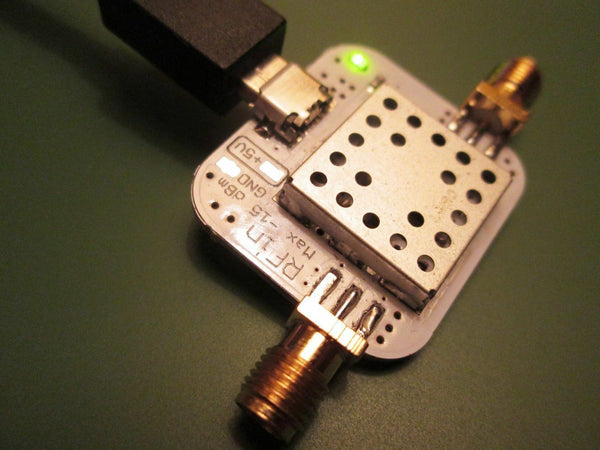
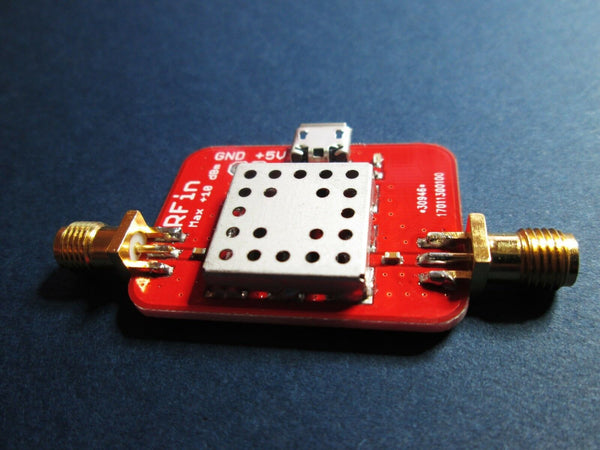
This is a tiny low noise amplifier with a built-in output Bias Tee. It can be powered by USB, a DC header, or DC injected directly on the RF output cable — giving you the flexibility to power it from a laptop, a bench supply, or your SDR's own bias tee, whichever is most convenient for your setup.
Any SDR with at least a +3.3V bias tee source, including RTL-SDR, can power this device directly through the RF cable. It also includes an ESD protection diode at the input to guard against static damage.
This LNA works well across a range of receiver applications — Ham Radio, TV reception, and general SDR use — as a pre-amplifier placed close to your antenna. It operates across a wide DC supply range of +3.3V to +12V, with a noise figure of just 0.7 dB at 500 MHz.
Important whichever method you use to power this device — USB, DC header, or the RF cable itself — the same DC voltage will appear on the RF output. If your receiver doesn't have DC blocking on its input, this voltage can damage it. Check your receiver's specs before connecting.
FEATURES
- Wideband LNA operates from 10 MHz to 3 GHz
- 0.7 dB Noise Figure at 500 MHz
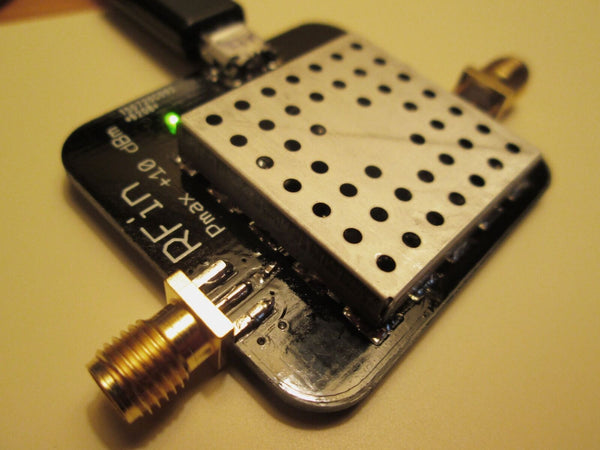
- LED power indicator
- SMA-F connectors
- Wide DC supply range +3.3V to +12V
- USB powered (Micro USB cable not provided)
SPECIFICATIONS
GAIN
| FREQUENCY (MHz) | GAIN (dB) |
| 10 | 17 |
| 50 | 21 |
| 100 | 22 |
| 500 | 19 |
| 1000 | 17 |
| 2000 | 12 |
| 3000 | 5 |
Output IP3 @ 2 GHz
+30 dBm
Maximum RF Input Power
+17 dBm
Which Output Bias Tee LNA Should I Choose?
This module and our standard Output Bias Tee LNA share the same core design and specs — the difference is power flexibility. This version adds USB as a power option alongside the standard DC header and DC-on-cable methods, which is genuinely useful if you want to power it directly from a laptop for bench testing or a portable setup. If you're always powering it from a bench supply or your SDR's own bias tee, the standard version does the same job.
Need to power something further upstream, like an active antenna? Neither of these has an input-side bias tee — see our Inline Amplifier with Input + Output Bias Tee instead.
New to remote LNAs?
Read our guide: What Is a Remote LNA? — or use our LNA Placement Calculator to see how much this LNA improves your specific setup's noise figure.